- YouTube operates as a recommendation engine, not a traditional search platform. Winning visibility requires earning viewer delight, not chasing metadata or keyword positions.
- No video holds a permanent spot in YouTube results. The system serves personalized feeds shaped by each individual's watch patterns and satisfaction responses.
- Dashboard numbers like view counts and follower growth have no direct influence on how far a video travels. The real distribution drivers sit in satisfaction data.
- Publishing around broad subjects falls flat when no defined audience cares enough to click, stay, and return. Aligning each video to specific viewer motivations beats topic coverage every time.
- Keyword stuffing, vanity metric chasing, and topic-first planning all stem from the same blind spot: optimizing for the platform instead of the person watching.
Brands spend months building YouTube strategies around keyword research, tag optimization, and metadata. They follow the same playbook that works on Google. Yet their videos sit at a few hundred views while competitors with simpler titles pull millions.
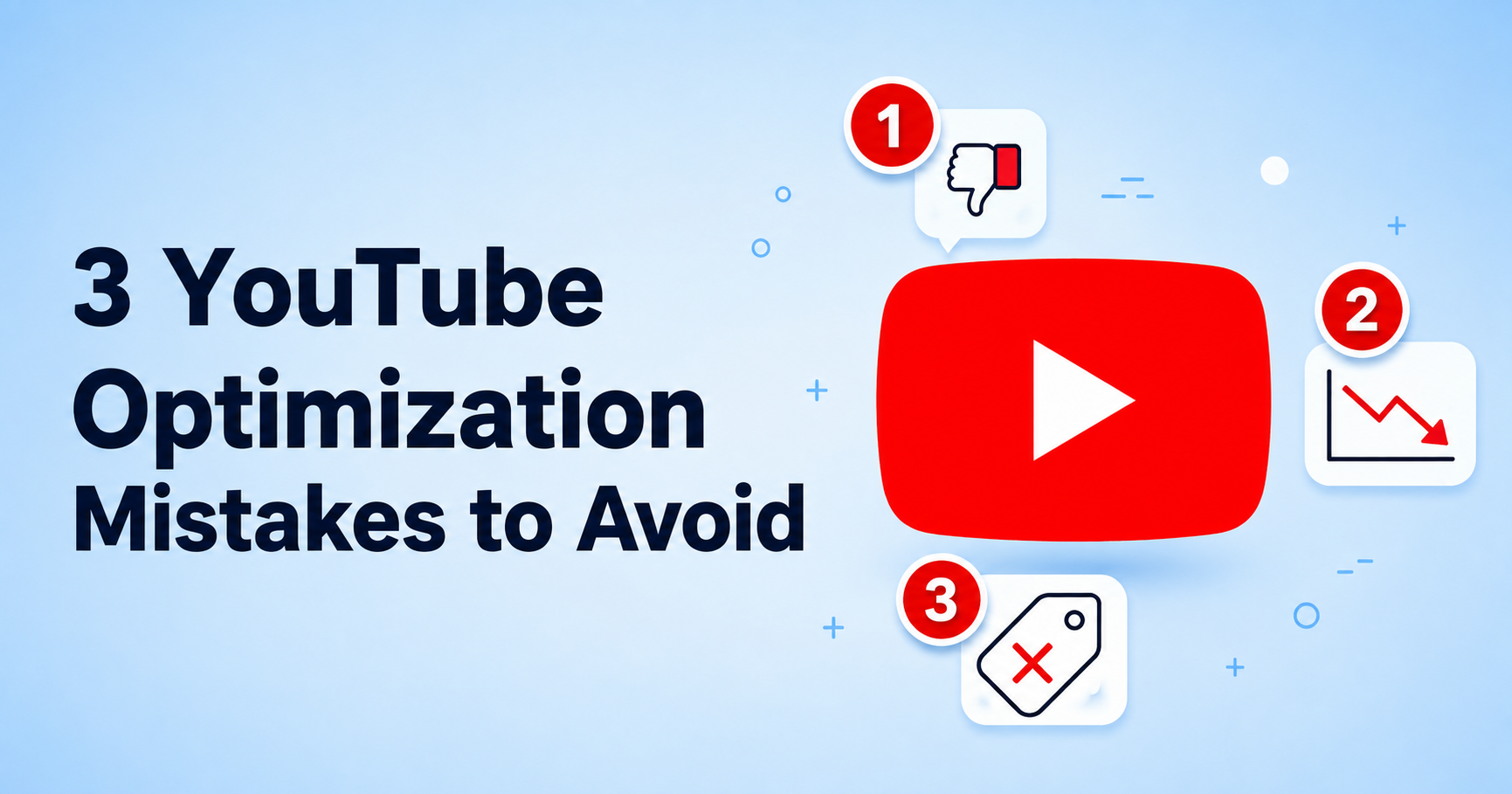
The gap is not about production quality or posting frequency. It comes down to three optimization mistakes that most marketing teams do not even realize they are making.
What Makes YouTube Different From A Search Engine
Google responds to what people type. YouTube responds to what people watch. That is the core difference, and it affects every optimization decision.
On Google, a user enters a query and gets the most relevant result. The interaction is transactional. YouTube works the other way around. It studies each viewer's behavior over time, tracks what they watch, skip, and return to, then serves content it predicts they will enjoy next. The viewer does not need to search. The content finds them.
This is why 70% of total watch time on YouTube comes from algorithmic recommendations, not from search or direct links. For marketers used to optimizing for traditional search, this requires a mental shift. Ranking on Google means winning a query. Earning recommendations on YouTube means winning a viewer's ongoing attention.
How YouTube's Recommendation System Decides What Viewers See
YouTube does not run one algorithm. It runs five, one each for Home, Suggested Videos, Search, Subscriptions, and Shorts. But all five evaluate the same core question: will this specific viewer enjoy this specific video right now?
Every video gets scored on three factors:
- Engagement: clicks, watch time, comments, shares
- Relevance: titles, descriptions, transcripts, on-screen text
- Satisfaction: post-view surveys, repeat views, return visits to the channel
In a Creator Insider interview, YouTube's Senior Director of Growth and Discovery, Todd Beaupré, confirmed that the platform now prioritizes how viewers feel about the time they spent watching, not just how long they stayed. A short video viewers love will outperform a longer one they simply tolerate.
Mistake 1: Treating YouTube Like Google Search
On Google, content ranks for queries. A page targets a keyword, holds a position, and marketers can track and defend that position over time.
YouTube does not work this way. There is no fixed ranking position for any video. Two viewers searching the exact same phrase can see entirely different results because the system personalizes everything based on individual watch history and satisfaction signals.
YouTube's own Search and Discovery guidance makes this explicit: the recommendation system does not promote videos to an audience. It finds videos for each viewer when they visit the platform.
| Google Search | YouTube |
|---|---|
| Reacts to queries | Reacts to viewer behavior |
| Puts content first | Puts the viewer first |
| Fixed ranking positions | Personalized, shifting results |
| Optimization = visibility to crawlers | Optimization = satisfaction for viewers |
When marketers miss this distinction, they default to search engine tactics: stuffing keywords into titles, overloading tags, and writing descriptions for crawlers. None of these address what actually drives distribution on YouTube.
Why Keyword-Stuffed Titles And Tags Fail On YouTube
YouTube uses natural language processing to read titles, descriptions, transcripts, and on-screen text. Exact keyword matches matter far less than topical alignment with what a specific viewer wants to watch.
A keyword-stuffed title might describe the content accurately. But if it does not make a viewer want to click, it fails. YouTube evaluates click-through rate as a core signal. A low CTR suppresses distribution, not expands it.
Tags are even less impactful. YouTube's own documentation states they are "not important" and exist primarily to correct spelling mistakes.
Mistake 2: Chasing Creator Metrics Instead Of Viewer Satisfaction
YouTube's recommendation system serves every viewer a personalized feed built around their own behavior. It does not decide what to show someone based on a channel's total view count, subscriber number, or overall popularity.
Yet most marketing teams still measure YouTube success by these creator-side metrics. Views go up, the dashboard looks healthy, and the team moves on. The problem is that these metrics describe what already happened. They do not influence what the system recommends next.
The algorithm is not a gatekeeper with preferences. It is a prediction engine. It learns what individual viewers enjoy and serves them more of it. "Pleasing the algorithm" is the wrong goal. Pleasing viewers is what compounds. This is a familiar trap in digital marketing where strong surface metrics mask a deeper performance problem.
What Views, Likes, & Subscribers Actually Tell The Algorithm
| Metric | What marketers assume | What it actually signals |
|---|---|---|
| Views | More views = more reach | A viewer clicked, not that they enjoyed it |
| Likes | High likes = strong content | One of hundreds of signals, not a primary driver |
| Subscribers | Big count = bigger audience | Early access to uploads, does not control distribution |
| Watch time | Longer = better | Now weighted by satisfaction; short and satisfying beats long and tolerated |
The signals that actually drive recommendations are harder to see in Studio:
- Post-view survey responses ("Was this video worth your time?")
- Session continuation (did the viewer keep watching or close the app?)
- Repeat views and return visits within seven days
- Shares outside YouTube (WhatsApp, iMessage, email)
A video with modest views but strong satisfaction will consistently outperform a viral video that viewers abandon halfway through.
Mistake 3: Optimizing For Topics Instead Of Viewer Interests
On Google, a page can still be found through the words on it. A well-optimized article on "cloud security best practices" will surface when someone searches for that phrase, regardless of whether the reader cares deeply about the topic.
YouTube does not work this way.
Content built around a topic nobody is actively interested in simply gets ignored. The system does not reward topical coverage. It rewards viewer response. If no one clicks, watches, or engages, the video disappears from recommendations no matter how well the metadata is written.
This is the same principle behind building website content around your ideal audience's actual interests rather than just keyword volume. The question is not "does this topic have search demand?" It is "does our specific audience want to watch or read this right now?"
And that alignment has to happen fast. Viewers decide within the first few seconds whether to keep watching, and that early response shapes how much of the video they see. A strong hook holds attention well past the halfway point; a weak one loses viewers before the content gets going.
How To Map Content To Audience Interests, Not Just Keywords
Keyword research tells you what people type. It does not tell you what they want to watch. Mapping content to viewer interests requires a different starting point:
- Start with YouTube Analytics audience data, not keyword tools. Look at what your existing viewers already watch outside your channel.
- Study Suggested Videos on competitors' top-performing content. These reveal what the algorithm groups together based on shared audience behavior.
- Use YouTube's Research tab in Studio to find topics your audience is actively searching for but not finding enough content on.
- Test with titles that reflect a viewer's situation, not just a subject. "Why your firewall logs miss lateral movement" speaks to an interest. "Firewall log analysis" describes a topic.
The difference between a topic and an interest is specificity. Topics are broad. Interests are personal. YouTube's system is built to serve the personal version.
What YouTube Optimization Trends Matter In 2026 (AI, Search & Discovery)
Four trends are reshaping how content gets discovered on YouTube.
- Conversational search is here. According to the YouTube Blog, the new "Ask YouTube" feature lets users ask full questions instead of typing keywords. Content now needs to answer questions, not just target phrases.
- Shorts and long-form run on separate algorithms. According to Search Engine Journal, YouTube decoupled the two engines in late 2025. Each format needs its own strategy.
- Satisfaction has replaced watch time as the top signal. On Creator Insider, YouTube's Senior Director of Growth confirmed the platform now prioritizes how viewers feel over how long they stayed.
- Shorts hit 200 billion daily views. According to Wytlabs, Shorts is now a standalone discovery channel too large for brands to ignore.
Build A YouTube Strategy That Wins Viewers
The three mistakes in this article share a common root. They all come from treating YouTube like a platform that rewards content. YouTube rewards viewers.
Stop optimizing for crawlers. Stop measuring success by vanity metrics. Stop building content around topics no one wants to watch. Start with one question: will this make the experience better for the specific audience the brand wants to reach?
This viewer-first framework is exactly how LeadWalnut, rated 4.5/5 on SalesHandy, approaches SEO, content strategy, and video marketing for enterprise B2B brands. The same principles that win on YouTube drive results across every discovery channel.
FAQ
How often should brands post on YouTube to grow?
Consistency matters more than frequency. YouTube has found no correlation between upload frequency and view growth. One high-quality video per week outperforms three mediocre ones.
What role do tags play in YouTube video discovery?
Minimal. YouTube confirms tags are "not important" and exist mainly to correct common spelling mistakes. Titles, descriptions, and spoken content carry far more weight.
Why does YouTube not penalize AI-generated video content?
YouTube evaluates all videos on the same satisfaction and engagement signals. Properly disclosed AI content is ranked normally. Only undisclosed or mass-produced AI content risks removal.
Can a small YouTube channel outrank a large one?
Yes. YouTube evaluates each video individually based on viewer satisfaction, not channel size. A strong video from a small channel can outperform established competitors.
How do YouTube Shorts affect long-form video performance?
They do not. YouTube separated the two recommendation engines in late 2025. Poor Shorts performance no longer affects long-form reach and vice versa.



How can LeadWalnut help?

Related Articles
Why Backlinks Are Now The Primary Driver Of Brand Mentions In AI Answers

AI Content Creation That Search Engines And LLMs Trust