Content optimization is the systematic process of improving web content so it ranks higher in search engines, gets cited by AI platforms, and converts visitors into qualified pipelines. For B2B SaaS companies, this means aligning every page with search intent, structuring it for AI extraction, and building conversion pathways that turn organic traffic into demo requests and revenue.
Why Does Content Optimization Matter for B2B SaaS Companies?
Content optimization matters because organic search generates 44.6% of all B2B revenue, according to BrightEdge's Channel Performance Report yet most B2B SaaS companies fail to connect that traffic to pipeline outcomes. Publishing content without optimizing it for both visibility and conversion is like building a storefront with no door.
The gap is costly. According to the Content Marketing Institute's 2025 B2B Report, 56% of B2B marketers struggle to attribute ROI to their content efforts. That disconnect often traces back to content that ranks but doesn't convert or content that converts the few visitors it gets but never achieves meaningful visibility.
For B2B SaaS companies with complex buying cycles averaging 134 days, content optimization ensures that every touchpoint from a first-touch blog post to a bottom-of-funnel comparison page works harder. The right optimization strategy improves rankings, earns AI citations, and moves buyers through the funnel toward a demo request or sales conversation.
What Are the Core Elements of a B2B Content Optimization Strategy?
A B2B content optimization strategy is a structured framework that aligns content creation, technical SEO, and conversion design to maximize both search visibility and pipeline generation. It goes beyond keyword stuffing and meta tags to address how content performs across traditional search, AI search engines, and the buyer's decision journey.
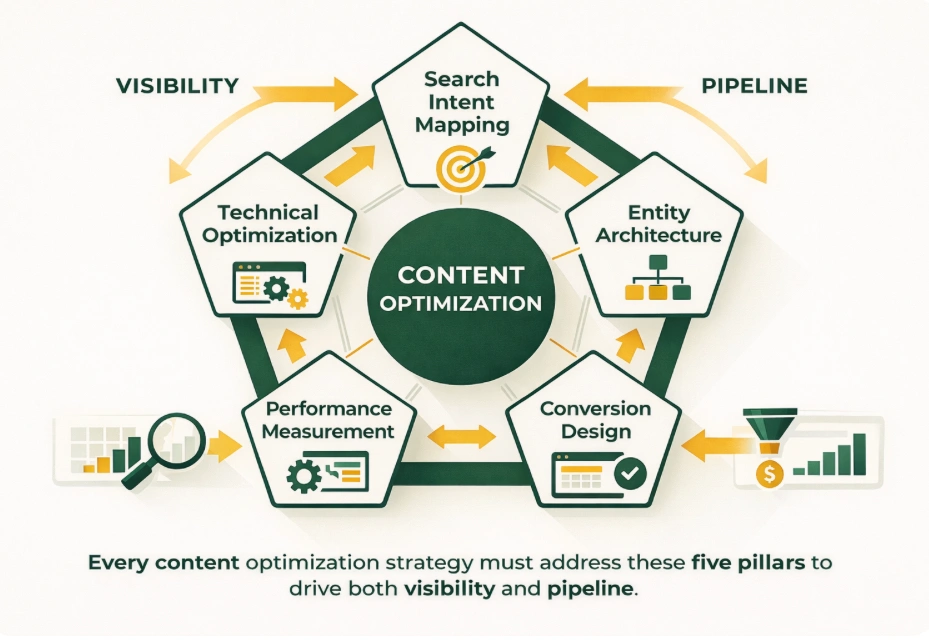
Here are the five pillars that every effective content optimization strategy must address:
Each pillar reinforces the others. Technical optimization improves both crawl efficiency and user experience. Intent mapping drives both relevance signals and conversion alignment. This is why siloed approaches SEO without CRO, or CRO without SEO leave a pipeline on the table.
How Do You Optimize Content for Search Engines and AI Platforms in 2026?
Content optimization for search in 2026 requires dual-track thinking: optimizing for traditional Google rankings and for AI-generated answers in platforms like ChatGPT, Perplexity, and Google AI Overviews. B2B SaaS companies that only optimize for one miss half their potential visibility.
For traditional search rankings:
Start with search intent research. Every page should target a specific intent informational "what is content optimization"), commercial ("best content optimization tools for B2B"), or transactional ("content optimization services"). Map keywords to funnel stages so that awareness content feeds consideration pages, which feed conversion pages.
Structure content with clear H1-H2-H3 hierarchy. Use your primary keyword in the H1, and format H2s as questions your target persona actually asks. Keep sentences under 20 words and paragraphs to 3-4 lines. According to a Semrush study on content performance factors, articles with a clear structure and 7+ headings receive 36% more traffic and 38% more shares than poorly structured content.
For AI search citation:
AI platforms prioritize content that is entity-rich, factually dense, and passage-extractable. Define key terms explicitly using "X is Y" format AI models cite definitions more frequently than narrative content. Each H2 section should be self-contained so any section can be extracted and still make complete sense. Include specific statistics with named sources AI engines weight cited claims higher than unsourced assertions.
What Does a Content Optimization Workflow Look Like Step by Step?
A content optimization workflow is a repeatable process that takes a piece of content from research through publication and ongoing performance measurement. For B2B SaaS teams, this workflow must integrate both SEO and CRO checkpoints at every stage.
Step 1: Research and intent mapping. Identify the primary keyword, map search intent, and analyze the top-ranking competitors. Determine which funnel stage this content serves and what conversion action the reader should take.
Step 2: Outline with entity architecture. Define your primary entity and 3-6 supporting entities. Structure H2 sections as self-contained passages. Plan where stats, tables, and CTAs will appear.
Step 3: Draft with dual-focus. Write the direct answer block first (40-60 words answering the H1). Build each section with a claim-evidence-source-implication pattern. Every section discussing visibility should address conversion implications. Every section discussing conversion should reference how search traffic feeds it.
Step 4: Technical optimization. Add schema markup (Article + FAQPage minimum). Optimize meta description to 155-160 characters. Compress images, write keyword-rich alt text, and ensure page loads in under 2 seconds.
Step 5: Internal linking and CTA placement. Add 5-8 internal links to related content using descriptive anchor text. Place CTAs at the soft, mid, and end positions. Tag every CTA link with UTM parameters for GA4 attribution.
Step 6: Publish and measure. Track organic sessions, keyword rank, CTA clicks by position, form submissions, and AI citation appearances. Set a 90-day review trigger.
How Do You Measure Content Optimization ROI?
Content optimization ROI is measured by connecting organic visibility metrics to pipeline and revenue outcomes not by tracking rankings or traffic alone. For B2B SaaS marketing leaders under pressure to prove content's business value, this is the most critical step.
The formula is straightforward:
Article Pipeline Value = (Form submissions from article) × (Average deal value) × (Close rate)
An article generating 10 form submissions per month, feeding into a pipeline with $50,000 average deal value and 15% close rate, produces $75,000 in pipeline value. That number justifies continued investment in content optimization far more effectively than a keyword ranking report.
Track these metrics per article, per month:
According to SeoProfy's B2B SEO benchmarks, the average ROI from SEO for B2B SaaS companies is 702%, with a break-even period of just 7 months. But that ROI only materializes when content is optimized for conversion, not just visibility
What Are the Most Common Content Optimization Mistakes in B2B SaaS?
Content optimization failures in B2B SaaS typically fall into five patterns. Each mistake impacts both visibility and conversions reinforcing why optimization must address both dimensions simultaneously.
Mistake 1: Optimizing for keywords without intent. Targeting high-volume keywords that don't match your buyer's funnel stage drives unqualified traffic that never converts. A cybersecurity SaaS company ranking for "what is a firewall" attracts students, not enterprise buyers.
Mistake 2: Ignoring AI search entirely. B2B buyers increasingly use ChatGPT and Perplexity during purchase research. Content that isn't structured for AI extraction with clear definitions, cited stats, and self-contained passages loses visibility in this growing channel.
Mistake 3: Publishing without conversion pathways. An article without CTAs, without internal links to service pages, and without keyword-to-revenue mapping is a branding exercise. Every page should move the reader one step closer to a business conversation.
Mistake 4: Setting and forgetting. Content is not a one-time asset. Pages with outdated statistics, broken links, or stale year references lose both rankings and credibility. Schedule quarterly content audits to keep your highest-performing pages current.
Mistake 5: Separating SEO and CRO teams. When SEO drives traffic and CRO optimizes conversion independently, neither team can attribute results or identify compounding improvements. Integrated enterprise CRO tactics applied alongside SEO strategy consistently outperform siloed approaches.
What Tools Do B2B SaaS Teams Use for Content Optimization?
Content optimization tools fall into three categories: research and visibility, technical auditing, and conversion measurement. For B2B SaaS teams, the most effective stacks combine at least one tool from each category rather than relying on a single platform.
Ahrefs : Primary tool for keyword research, competitor content gap analysis, and backlink tracking. Use it to identify which content pages competitors rank for that you don't, and to monitor ranking movement after each content refresh.
Semrush : Complements Ahrefs with content audit features, on-page SEO scoring, and topic cluster mapping. Its Content Audit tool is particularly useful for identifying pages that are eligible for a refresh based on traffic decline.
Google Search Console : Free and non-negotiable. Tracks which queries your content actually ranks for versus what you targeted, and surfaces indexing issues before they compound into ranking losses.
Google Analytics 4 :Attribution source for all conversion tracking. Every CTA in your content should be tagged with UTM parameters and traced to a GA4 conversion event so pipeline contribution is measurable at the article level.
How Often Should You Audit and Refresh Existing Content?
Content auditing is the process of systematically reviewing published content against performance benchmarks and quality standards. For B2B SaaS companies, LeadWalnut recommends auditing your top 20 pages quarterly and running a content coverage analysis on your full blog inventory every six months.
Refresh triggers include: any cited statistic older than 12 months, rankings dropping 5+ positions for the primary keyword, a decrease in AI citation frequency, or any page that has generated zero conversions after 90 days.
When refreshing content, prioritize these actions: update all year references to the current year, add at least one new statistic from a current source, check and replace any broken external links, add internal links to articles published since the original publication date, and refresh the meta description if it references a dated year or outdated claim.
The ROI of content refreshes is well-documented. Teams that audit and update existing content consistently see stronger results than teams focused exclusively on new content production because updated pages retain their domain authority and backlink equity while gaining freshness signals that improve both rankings and AI overview optimization.
How to Future-Proof Your Content Against Google Algorithm Changes
The world of SEO is a dynamic landscape, constantly reshaped by Google's algorithm updates. Staying attuned to these changes is akin to mastering the changing scales in a symphony, where each shift can alter the entire composition of your SEO efforts.
- Understand the Impact of Google Algorithm Updates: Google's updates can significantly affect your content's visibility and ranking. Therefore, understanding these changes and their potential impacts is vital in the realm of content optimization.
- Adapt Your Content Optimization Strategy: Each algorithm update calls for a renewed strategy. Be flexible and ready to adapt your content optimization efforts in response to these changes to keep your content relevant and optimized.
- Monitor Algorithm Updates: Regularly monitor SEO news and Google's updates. Tools like Google Search Console can provide valuable insights into how updates may affect your site's performance.
- Revise and Update Content: In the face of new algorithm updates, be proactive in revising and updating your content. This ensures that your content stays fresh, relevant, and in tune with the latest SEO guidelines.
- User Experience is Key: No matter the changes in the algorithm, a consistent element that Google values is user experience. So, focus on creating engaging, high-quality, and user-friendly content.
The Bottom Line on Content Optimization for B2B SaaS
Content optimization is not a publishing checklist, it is a revenue system. For B2B SaaS companies, every page that ranks without converting is an asset operating at half capacity, and every page that converts without ranking is a pipeline source you cannot scale. The framework in this guide intent mapping, entity architecture, technical execution, conversion design, and performance measurement is built to close that gap by making visibility and pipeline generation inseparable from the same workflow.
The companies that will consistently win organic pipeline in 2026 are those treating content as a dual-channel asset: optimized for traditional search rankings and structured for AI citation simultaneously. That shift is already underway. The question is whether your content inventory is positioned to benefit from it or to be displaced by competitors who are.
FAQ
What is content optimization?
Content optimization is the process of improving web content to increase search engine rankings, earn AI platform citations, and convert visitors into qualified pipelines. It combines keyword targeting, content structure, technical SEO, and conversion design to ensure every page drives measurable business outcomes.
How is content optimization different from SEO?
SEO is one component of content optimization. While SEO focuses on technical factors like crawlability, backlinks, and keyword targeting, content optimization also addresses content quality, conversion pathways, AI search readiness, and alignment with buyer intent. The most effective strategies treat SEO and CRO as inseparable parts of the same optimization process.
How often should B2B SaaS companies optimize their content?
B2B SaaS companies should audit their top-performing pages quarterly and their full content library every six months. Any page with outdated statistics, declining rankings, or zero conversions after 90 days should be prioritized for immediate refresh.
What tools are best for B2B content optimization?
Essential tools include Semrush or Ahrefs for keyword research and rank tracking, Google Analytics 4 for conversion attribution, Google Search Console for technical health, and AI monitoring tools for tracking citation appearances in ChatGPT, Perplexity, and Google AI Overviews. For a comprehensive view of available options, see our guide to AI search optimization tools.
How do you measure content optimization ROI?
Content optimization ROI is measured by calculating Article Pipeline Value: form submissions from the article multiplied by average deal value and close rate. This connects organic visibility directly to revenue, replacing vanity metrics like traffic volume or keyword count.
Does content optimization help with AI search visibility?
Yes. Content structured with clear entity definitions, cited statistics, self-contained passages, and schema markup is significantly more likely to be cited by AI platforms like ChatGPT, Perplexity, and Google AI Overviews. This emerging channel is becoming critical for B2B SaaS discovery.



How can LeadWalnut help?

Related Articles
Why Backlinks Are Now The Primary Driver Of Brand Mentions In AI Answers
AI Content Creation That Search Engines And LLMs Trust