Picking the right digital marketing agency has always been a high-stakes decision. In 2026, it is a higher-stakes one. Marketing budgets are flat, AI is rewriting how search works, and a single weak partner can cost a CMO a full fiscal year of pipeline.
This guide covers the exact criteria, questions, and selection process needed to evaluate a digital marketing agency in 2026. It also includes the AI-readiness checks most buyers are still skipping.
Why Choosing a Digital Marketing Agency Just Got Harder
According to the Gartner 2025 CMO Spend Survey, 39% of CMOs plan to cut agency budgets, with top actions being eliminating underperforming agency relationships and streamlining agency rosters. Most marketing leaders are not choosing a new agency from scratch. They are replacing or consolidating a roster where something already failed.
At the same time, the search itself is being rewritten. An Ahrefs analysis of 146 million queries found that Google AI Overviews now appear on 20.5% of all keywords, and on 57.9% of question-based searches. An agency that still treats traditional rankings as the primary outcome is building a strategy against a shrinking surface area. The stakes on every selection decision are higher, and the skill gap between agencies has widened.
6 Signs Your Business Needs a Digital Marketing Agency
Most companies wait too long to bring in an agency. By the time the decision is made, a full quarter of the pipeline has already been lost. These are the signs it is time to act.
- The pipeline is inconsistent: Deals close but nothing is filling the top of the funnel. There is no repeatable system and every month feels like starting over.
- The in-house team is at capacity: Strategy, execution, reporting, and creativity are all sitting with the same people. Everything is getting done. Nothing is getting done well.
- Search visibility is slipping: Rankings have dropped. The brand is not showing up in ChatGPT or Google AI Overviews. Buyers are finding competitors before they find you.
- A new market cannot wait for a hiring cycle: A new product or segment needs traction now. Hiring and ramping an internal team takes 9 months. That is 9 months of lost ground.
- Marketing cannot prove its impact to the CFO: The team reports on clicks and impressions. The CFO asks about the pipeline. There is no bridge between the two.
- The team is unable to adopt AI and scale output: Workflows are still manual. Content takes weeks instead of days. Competitors using AI for research, drafting, and optimization are shipping faster and with higher quality.
If two or more of these sound familiar, the cost of waiting is already higher than the cost of the right agency.
Freelancer, In-House Team, or Agency: What Is the Right Call?
What an Agency Does That Your In-House Team Cannot
Breadth without the hiring cycle: One retainer covers SEO, content, technical, and paid. Building that team internally takes a minimum of 12 months.
AI search methodology, already built: Most in-house marketers are still learning GEO and AEO. Specialist agencies have tested it across clients and know what gets a brand cited in ChatGPT and Perplexity.
Pattern recognition across industries: An agency working with 10 to 20 B2B companies sees what is working right now. An in-house team only sees one brand.
Enterprise tools without the overhead: SEO, LLM visibility, and content intelligence platforms cost $30,000 or more annually. Agencies absorb that cost across their client base.
Faster iteration: Agencies run refined playbooks. In-house teams build that knowledge from scratch, which means slower cycles and more avoidable mistakes.
5 Evaluation Criteria for a Digital Marketing Agency
Five criteria separate agencies worth shortlisting from those that are not. Strategic fit, proof of results, transparent reporting, team quality, and tech infrastructure. Every shortlisted agency should clear all five before any discussion about AI-readiness begins.
1. Strategic Fit and Industry Expertise
Strategic fit means the agency has worked with companies at a similar stage, in a similar motion, with similar buying committees. A B2B SaaS company with a six-figure ACV should not shortlist agencies whose portfolio is built on e-commerce. Ask for three clients in the last 24 months that match the company's size, model, and geography. Agencies that can name them instantly are the ones worth a second meeting.
2. Proof of Results With Measurable Outcomes
"We drove traffic" is not proof. Marketing leaders should ask for outcomes tied to revenue or pipeline: qualified leads generated, SQL-to-opportunity conversion lifts, or ranked pages that produced measurable demo requests. Strong agencies surface third-party validation through platforms like Clutch, G2, and TrustPilot, along with named references. Independent editorial roundups carry the same weight — for example, Saleshandy's list of leading lead generation companies in India, which signals external recognition of the agency's work and methodology. Weak ones lean on vanity metrics.
3. Transparency in Reporting and Communication
Transparent reporting has three elements: a live dashboard, a fixed cadence, and a named point of contact. The dashboard should show leading indicators (rankings, impressions, AI citations) and lagging ones (traffic, conversions, pipeline). The cadence should be weekly or biweekly, not quarterly. The contact should be senior enough to change course without escalation.
4. Team Composition and Senior Involvement
Marketing leaders should always ask who actually does the work. Many agencies pitch with senior strategists and staff the account with juniors. Confirm the specific team, their tenure, and how many accounts each person carries. A strong rule of thumb: the pitch team and the delivery team should overlap by at least 60%.
5. Tech Stack and Data Infrastructure
Agencies without a modern tech stack cannot deliver modern outcomes. Expect to see Ahrefs or Semrush for keyword and competitive data, Screaming Frog for technical audits, and increasingly, a dedicated LLM visibility tool such as Profound, Conductor, or Peec AI. An agency that cannot name its stack without hesitation is an agency running on spreadsheets.
The AI-Readiness Criteria Most CMOs Miss
AI-readiness criteria evaluate whether an agency can optimize for AI search engines and large language models, not just Google's traditional results page. This is the layer most evaluation frameworks skip, and it is the layer that determines whether a brand stays visible as AI answers replace blue links.
LLM and AI Search Visibility Tracking
Ask the agency how they measure brand visibility inside ChatGPT, Perplexity, Claude, Gemini, and Google AI Overviews. The right answer includes specific tools (Profound, Conductor AI, Peec, Otterly) and specific metrics (share of voice, citation frequency, co-occurrence with competitors). If the agency cannot demonstrate a tracked dashboard showing LLM visibility tracking for a live client, they are not doing this work — they are talking about it.
Generative Engine Optimization (GEO) and AEO Methodology
Generative Engine Optimization (GEO) and Answer Engine Optimization (AEO) are the two methodologies that improve a brand's chance of being cited by AI systems. A mature agency will describe a clear process: prompt research, answer-first content structure, entity and schema optimization, citation-worthy original data, and link-building designed to reinforce topical authority. If the pitch is "we do SEO plus some ChatGPT stuff," the agency has not built the methodology yet.
Content Strategy Designed for AI Citation
Content designed for AI citation looks structurally different from the 2019 content. Every section opens with a direct, extractable answer. Tables, numbered lists, and named frameworks are the preferred formats because LLMs pull from these cleanly. The unit of optimization is entities, not just keywords. Ask the agency to share a recent article they published and walk through exactly which sentences were written to be cited.
10 Questions to Ask Before You Sign a Marketing Agency
These ten questions surface the gaps a capabilities deck will hide. Marketing leaders should use them in the second meeting, after the pitch.
- Which three clients in the last 24 months most resemble our stage, size, and motion?
- What percentage of the pitch team will actually work on our account each week?
- How do you measure and report brand visibility inside AI answer engines?
- Show one live client dashboard that includes LLM citation tracking.
- What is your turnover rate on senior account leads, and who is leaving this year?
- What is the first 90-day plan you would run for us, and what outcomes would you commit to?
- Which channel or tactic would you explicitly not recommend for our buyer, and why?
- What does your content production process look like from brief to publication?
- How do you handle a quarter where rankings move but pipeline does not?
- What is your exit clause, and how much notice do you need to wind down cleanly?
A strong agency answers eight or more of these without a follow-up call. A weak one asks to come back with the numbers.
Red Flags That Should End the Conversation
Some signals warrant walking away, no matter how strong the pitch deck:
- Case studies with no named companies or independently verifiable outcomes.
- A fixed monthly retainer with no clarity on deliverables or hours.
- No measurement framework for AI answer engines beyond “we watch rankings.”
- Account lead turnover above 25% in the last 12 months.
- Pushback on letting the marketing team speak directly to a current client reference.
- Templated reporting that does not change between industries.
- An AI strategy that consists of “we use ChatGPT to write content.”
Any two of these in the same evaluation should trigger a pause. Any four should close the conversation.
Digital Marketing Agency Pricing: What to Know Before Signing
Most digital marketing agencies use one of three pricing models. Understanding each before shortlisting begins removes budget surprises and puts marketing leaders in a stronger negotiating position.
- Monthly Retainer
The most common model for ongoing digital marketing work. B2B retainers typically range from $5,000 to $30,000 per month. Full-service engagements generally start at $15,000 per month. Without specific deliverables tied to the fee, the engagement becomes a maintenance cost rather than a growth investment.
- Project-Based Fees
Covers a specific, time-bound deliverable. Common examples include technical SEO audits, GEO content sprints, and LLM visibility assessments. Well-suited for scoped pilots before a longer commitment is made.
- Hourly Rates
More common in advisory arrangements. Difficult to forecast at enterprise scale. Most B2B marketing leaders prefer retainer or project-based structures for budget predictability.
A Step-by-Step Agency Selection Process
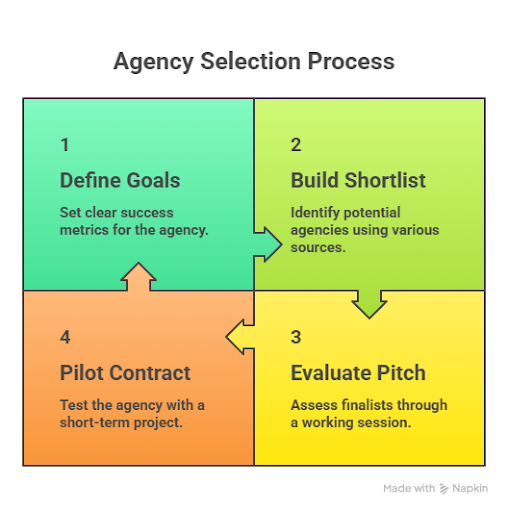
A structured selection process removes bias, shortens the cycle, and makes the decision defensible to the CFO and CEO.
1. Define Your Goals and Success Metrics
Start by writing down the one metric that will define success in 12 months: qualified pipeline, SaaS trial signups, demo requests, branded AI citations, or enterprise meetings booked. Everything downstream flows from that single number. Agencies that cannot map their deliverables to it should not make the shortlist.
2. Build a Shortlist and Issue an RFI
Build a shortlist of five to seven agencies using sources like Clutch, G2, peer CMO referrals, and specialized directories. Issue a short RFI — no more than eight questions — covering the core evaluation criteria. Eliminate agencies that cannot respond within ten business days.
3. Run a Structured Evaluation and Pitch
Invite three finalists to a working session, not a pitch theater. Share a real problem, give each agency 48 hours, and evaluate how they frame the work, what they push back on, and how they think under time pressure. Score each agency against a predefined scorecard so the decision is based on evidence, not charisma.
4. Pilot Before a Long-Term Contract
Start with a 90-day paid pilot, scoped to one or two deliverables and a clear success metric. A pilot gives both sides a reversible commitment and surfaces operational issues — slow responses, weak writing quality, poor senior involvement — before a 12-month contract locks them in.
Future-Proofing Your Marketing Agency Partnership
The agencies that will still be delivering results in 2028 are the ones treating AI search and LLM visibility as a core competency today. Marketing leaders should evaluate a prospective partner less on what they are ranking for this quarter and more on how quickly they adapt when the search landscape shifts again.
The strongest evaluation framework combines traditional rigor (proof of results, team quality, reporting transparency) with an honest audit of AI-readiness. For marketing leaders who want a partner built for AI-era search, GEO, and AEO, one question starts the right conversation. What does a client's LLM visibility look like today, and what did it look like 90 days ago?
FAQ
How much does a digital marketing agency cost for a B2B company?
B2B digital marketing agency retainers typically range from $5,000 to $30,000 per month, depending on scope, industry, and depth of strategy work. Full-service engagements covering SEO, AEO, paid, and content production usually start at $15,000 per month. Pilot engagements can be scoped lower.
What to look for when evaluating an agency's AI Search capabilities during the pitch?
Ask the agency to pull up a live LLM visibility dashboard for a current client during the pitch. If that cannot be produced in the room, the agency is not actively doing this work
What is the difference between a full-service digital marketing agency and a specialized SEO or AEO agency?
Full-service agencies cover paid, social, content, email, and SEO under one roof. Specialized agencies go deeper on a single channel, which is often the better fit when the company already has strong internal coverage elsewhere. Most modern B2B programs pair a specialized SEO or AEO partner with in-house demand generation.
Should a B2B company hire an in-house marketer or a digital marketing agency?
The answer depends on the maturity of the program. Early-stage companies move faster with an agency because it buys senior thinking and a full stack of tools. Mature programs often bring strategy in-house and use agencies for specialized execution, such as technical SEO audits or AEO methodology.
How do you measure ROI from a digital marketing agency?
Tie agency spend to pipeline sourced, pipeline influenced, and cost per qualified opportunity. Rankings and traffic are inputs, not outcomes. If the agency cannot show how their work maps to the pipeline numbers the CFO tracks, the measurement framework is broken.



How can LeadWalnut help?

Related Articles
Why Backlinks Are Now The Primary Driver Of Brand Mentions In AI Answers
AI Content Creation That Search Engines And LLMs Trust